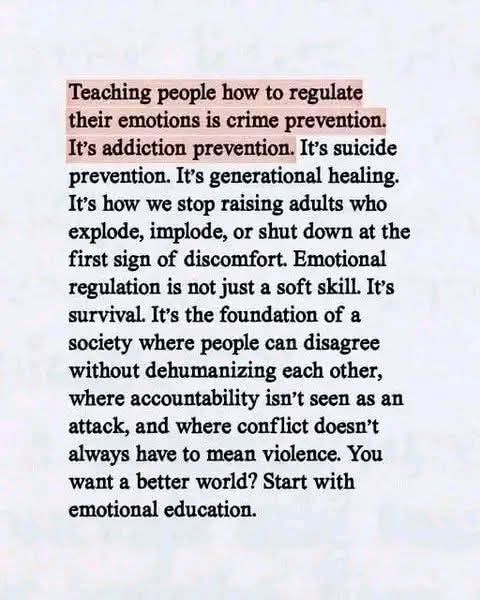
This concept intrigued me when I heard it, and I don’t know if you’ve heard of it or considered it before.
Many of us were brought up hearing similar sentences to these: “If you don’t stop crying, I’ll give you what-for!” “I brought you into this world, I can take you out!” Etc. Etc. Etc.
Those of us who are older know these kinds of words, for we were raised in fear and we received corporal punishment regularly. We received it at home and at school, for we could receive a spanking or “paddling” if we broke a rule. The manual many older generations relied on was the Bible, and an oft quoted phrase was “spare the rod and spoil the child”, which many took as divine guidance to beat children.
We weren’t taught how to regulate our emotions. We were told to smile even when we felt sad, for “there were others who had it worse than us”. We weren’t taught how to understand our emotions much less how to handle them in a healthy way, because our parents had no knowledge of how to themselves. They didn’t learn from their parents because they didn’t know how either. Does this explain some of the stuff you’re seeing?
In the past few years younger generations have been learning about how to handle their emotions in healthier ways, but it’s difficult when one is learning something new. These younger people in turn are trying to raise their kids in emotionally healthier ways than they had been brought up, and it’s a long learning process, and of course there have been some failures along with the successes, for no one was given a blueprint or manual.
As often happens, when one was brought up in an extremely strict way, one may go to the other side of the pendulum and be too soft, having no boundaries. Part of the “participation trophy” approach was in direct opposition to extremely harsh childrearing practices. Many see that as a failed attempt, and are now trying for more moderate, balanced approaches.
I decided to do a little dive into this topic, and found that teaching emotional regulation to kids and adults helps create better outcomes with regard to crime and addiction prevention.
In Psychology Today, Amanda L. Giordano Ph.D., LPC has an interesting article, “Is Emotion Regulation the Key to Addiction Prevention?“, with an eye-catching sub-title “Difficulties in emotion regulation are consistently linked to addiction.”
What is emotion regulation?
Since the 1990s, emotion regulation has been a key construct in social science research. In essence, emotion regulation is an individual’s ability to influence their emotional reactions using internal and external strategies (Gross, 1998; Thompson, 1994). Emotion regulation processes can modify the intensity, timing, quality, range, duration, and recovery from emotional experiences (Thompson, 1994). The ability to modify or regulate emotions is essential to existing in a social context; thus, deficits in emotion regulation skills can range from moderately challenging to severely incapacitating.
Amanda L. Giordano Ph.D., LPC, Is Emotion Regulation the Key to Addiction Prevention?
Of course, there have been some families who really understood emotional regulation in a healthy way, and not just suppressing or brushing emotions “under the rug”, but who were able to talk through their feelings as they related to events that came up. The rest of us dealt with parents and family members who had very short fuses and we had to tip-toe around them lest we unleash the monster.
When we deal with family members who use anger as a way to get what they want and who will belittle and disparage their family, we end up with a lot of collateral damage. If those family members also consume large quantities of alcohol and drugs, the damage is deeper, for often in the haze and rage many cruel things are said and that is often punctuated with physical violence.
It was and still is common for internal warfare to rage within families, and to the outside world they present a face of normalcy and peace. This warfare has damaged and traumatized untold amounts of our population, and people leave home bearing the inner scars. The inner pain of being belittled, criticized and emotionally (not to mention physically and sexually) abused has propelled too many people into seeking relief not in therapy or counseling, but in the release through alcohol, drugs and acting out aggressively towards others, or subconsciously seeking partners who exhibit the same behaviors of their parents because those are the most familiar patterns.
Unless we consciously choose new behaviors and ways of thinking, unfortunately, the old hurtful patterns tend to get repeated, not out of ill intent, but because the whole negative cycle was so deeply internalized.
I remember years ago I professed a desire to be different from my mother, so I wouldn’t end up repeating her patterns of parenting and how she treated people. I was told, “Well, good luck with that! You’re probably going to end up just like her, no matter what your current intentions are.” I was dumbstruck how they so easily dismissed my intentions, and until I realized that a) they were often projecting their own inadequacies onto me, b) it was going to take more than good intentions.
What is needed, if good intentions aren’t enough?
Good intentions are great, but they need to be backed up by actions. Consistent actions, not just sporadic ones seeking a pat on the head for good behavior.
Taking responsibility for our thoughts and our actions is only the first step. Working on actively changing how one reacts and sees everything as a threat or taking everything personally is crucial to the process. It’s quite difficult to change how one thinks and reacts, but it is doable.
What are the steps?
Laura Dimler, PhD in her article “Teaching Emotion Regulation Is Crime Prevention” on her blog Development Decoded
No, helping a toddler calm down won’t single-handedly stop a crime wave. But when kids learn to manage frustration, communicate anger, and recover from setbacks early in life, they’re far less likely to lash out, explode, or shut down in harmful ways later.
Helping kids manage big feelings isn’t just about stopping tantrums or teen blowups. Emotion regulation builds the brain skills that reduce aggression, risky behavior, and future harm to themselves and others. It really is prevention.
Laura Dimler, PhD in her article “Teaching Emotion Regulation Is Crime Prevention“
Often the parents who are trying to teach their kids how to do these things are themselves learning the same tools. Emotional regulation is a whole new practice and way of approaching everything in life, from grocery lines to traffic, from work relationships to home relationships.
How to build it:
Laura Dimler, PhD in her article “Teaching Emotion Regulation Is Crime Prevention“
- Practice calming tools: breathing (e.g., deep breaths, counting to 10, box breathing), movement (e.g., silliness, dancing, yoga), sensory input (e.g., stress ball, music).
- Name the feeling: “You’re really frustrated—let’s figure out what’s going on.” or even a vague, “It seems like you’re overwhelmed. Want to take a break together or talk it out?”
- Model regulation: Let them see you take a breath, name your own feelings, or recover after being upset (e.g., “I’m feeling stressed, so I’m going to grab some water and take a minute.”)
- Reflect after the moment: “What helped you calm down? What could help next time?”
- Repair when you mess up: “I got too upset and raised my voice. That wasn’t fair to you. I’m sorry and I’m working on it.”
- Normalize the process: Emotion regulation isn’t automatic. It grows with coaching, modeling, and practice, well into adolescence and adulthood
If you wish to learn more about these steps, I highly recommend reading her article in it’s entirety as well as buying a few parenting books. She has some other posts tat may be helpful too:
- Why the First Five Years Matter (Without the Fear-Mongering)
- The Science Behind the Good Enough Parent
- Calm the Chaos: Why Predictable Routines Help Kids Thrive
- Chores Aren’t About Responsibility
- Teaching Patience When “Waiting is Not Easy”
It starts with ourselves. If we aren’t living it, we can’t model it. If we can’t model it, we’ll just be hypocrites and expect our kids to do something we ourselves struggle with. We need to change ourselves and how we think to be able to change how we react to triggers and stimuli in our lives.
Good news, it’s doable, with effort!
Here are a few posts giving some guidance for those steps:
- Brain Rewiring
- Challenge: When a negative thought enters your mind, think three positive ones. Train yourself to flip the script!
- Change how you see and see how you change.
- Change the tapes!
- Changing our thoughts and habits Part 1: how does it physically work in the brain?
- Changing our thoughts and habits Part 2: how does it physically work in our body?
- It’s never too late to teach ourselves!
- Resilience is knowing that YOU are the only one that has the power and the responsibility to pick yourself up
- Science has proven that changing our inner dialogue changes our brain
- Scientifically speaking: The power of speaking kindly to ourselves and to others
- Turning Poison into Medicine
♥ ♥ ♥ ♥ ♥
Blessings!
Thank you for liking, sharing this post and for following me!
Tamara
I hope you’ll poke around my Archived Posts Main page divided up into 3 sub-pages: Mental Health and Rewiring the Brain || Healing and Developing Ourselves || Positive thoughts and Affirmations to find a wonderful trove of supportive and encouraging posts!
https://tamarakulish.com/
My books: Developing Happiness When You Can’t Find It and How to Heal Your Life on a Deep Heart Level are available in paperback and Kindle. Audiobooks are available for the busy person!
Guided Journals help you work on a particular issue by answering questions to help see patterns and to find solutions:
Removing Inner Blocks || Anger Journal || Guided Anxiety Journal || Joy & Mindfulness Journal || My Boundaries Journal || My Inner Thoughts Journal
Thanks for buying my books on Amazon!
#writing #InspirationalWriting #art #creativity #strength #mentor #teacher #HappinessGuru #love #growth #healing #life, #inspiration, #quotes #happiness #joy #PersonalGrowth #pain #depression #anxiety #SelfEsteem, #LifeSkills #empowerment #encouragement #support #intuition #journal #consciousness #mind #learn #God #universe #angels #spiritual #spirit #awareness #journal #boundaries #emotionalhealth #mentalhealth #emotions
Discover more from Tamara Kulish
Subscribe to get the latest posts sent to your email.

 Tamara Kulish
Yes! I’m so on board with this. That EMDR book I mentioned I was reading says that (almost) no one is beyond hope, including hardened criminals. With the exception of those who have experienced literal brain damage, so much healing and rehabilitation can come through healing, especially from EMDR.
LikeLike
It’s amazing what is possible when one chooses to make changes! Nothing is set in stone, it’s all learnable, but often just takes time and effort to put it into place in one’s life.
LikeLiked by 1 person
Exactly. The hard part is going through the pain of reliving the trauma in order to reprocess it and overcome, then come out better off on the other side. It’s not easy, but so worth it.
LikeLiked by 1 person
Yes, that’s the truly hard pard. I felt like I was being drawn and quartered, the pain was physical not just mentally reliving it. I thought I would die from it a few times, but I guess the pain comes from tearing up those deep, deep toxic roots that embedded themselves. The new tender sproutlings of new thoughts took a lot of mindful watering and care for them to finally flourish. As you said, the pain is bad, but once we come through it, we feel much better, so it was worth going through the healing to get there.
LikeLiked by 1 person
Oh man, Tamara, that sounds brutal. Was this EMDR or some other form of therapy? I’m so glad you made it through to the other side. ❤
LikeLiked by 1 person
I used art therapy on myself. Now that I completed the certification as an art therapy practitioner, I saw I was right on track with it. It’s a way of using visuals to allow the subconscious to show the solutions that are needed. I had also incorporated written words into the process to help myself see and understand.
LikeLiked by 1 person
Interesting!
LikeLiked by 1 person
Right? I incorporated all those lessons into my books. They’re a great way to look at healing.
LikeLiked by 1 person
❤
LikeLiked by 1 person
Wow – what a great post, Tamara. I think emotional regulation would go a long way to cure so many adult behavior. You’re right – teaching it to kids does involve learning it ourselves and that’s a fascinating journey. Thank you so much for the resources and info!
LikeLiked by 1 person
Thanks Wynne! We’ve definitely seen an uptick lately in disregulated behavior from people. People feel free to behave badly and unload on others. The entitlement is huge. They may have been that way before, but social media is sharing it for all to see. I hope we can all collectively grow up and become better behaved!
LikeLike
This was the one thing that I kept coming back to in the healing that I did. Why was it that it all begins in that childhood, that picking up and learning from our parents or those close to us and carrying it onwards. I thought, like you, emotional education in or out of school to start a life on such a more level playing field. And Spirit said…anybody coming to that class don’t want to admit anything is wrong with them (as a parent). And anything taught to our children becomes an argument simply because they love and look up to their parents at that age and copy that ‘looked up to’ image. If it was forced I can imagine the uproar (child or parent), simply because you are touching those fears already built.
Spirit then went on to say ‘life is that teacher’, of feeling those many emotions at so many depths with our experiences. And then realising to really heal we have to go inside and dare that truth awaiting within us. It is that moment that we finally see the love we have ever looked for, beyond that fear.
And yes, a class would be such a leveller of so much pain. But at what cost. Losing that chance to truly see a beauty that cannot be seen any other way, hence this life to do so.
A great post kind lady, a lesson in ‘seeing’ what is there and dare us to find ‘why’ 🤗❤️🙏
LikeLiked by 2 people
It isn’t the place of schools to teach what parents need to be teaching and modeling. As loving as a teacher is, the primary space for learning about love, respect and self worth needs to come from the parents because their relationship is for multiple years, not one school year. If we don’t learn these vital lessons from home, we try to learn them in life, but as you know, it’s definitely harder. When we finally learn those lessons, we can bring the knowledge to people through the examples we live and through how we treat people.
LikeLiked by 1 person
Indeed it isn’t up to schools Tamara. And, alas, the damage in the parents is passed on in those early years leaving its imprint on us. But as you said, it is in finding that love within us as we grow and experience it all. Going beyond our fears, that we then can pass on its beauty 🤗❤️🙏
LikeLiked by 1 person
So true Mark, so true.
LikeLiked by 1 person
Quite a tourdeforce, Tamara! I would add that for many parents who need assistance, we are short on support for mental health, medical, and school services. Government support is essential.
LikeLiked by 1 person
Thank you Dr. Stein. Yes, we all need additional support to move through life. I wish health services weren’t tied to employment, and that everyone had access to great care, both physical and mental health services. Imagine how much lower our crime rates would be? One only has to look at the Nordic countries to see living proof of this.
LikeLiked by 1 person
My upbringing was very similar to yours. It’s good to know that there are new ways of raising children to avoid the trauma we’ve been through. I imagine it will take a while to see the effectiveness of teaching emotion regulation in the behavior of future adults.
LikeLiked by 1 person
Yes, I believe you’re right Rosaliene, it will take a few generations before we see good results coming. I’m kind of tired of hearing older people saying they were brought up the old way and “it never hurt them!” I beg to differ when I see how they’ve struggled in their lives with anger and suppressed anger wreaking havoc on their mental and physical health.
LikeLiked by 1 person
So true, Tamara. At a time when my mother could’ve enjoyed spending time with me and my sons, she scared them away with her uncontrollable rage.
LikeLike
I’d never considered this, but, the more I do, I think it holds waters. Thanks for sharing this–I’ll be saving this for later!
My mom was an earlier childhood educator, so she fortunately had the tools to teach us emotional regulation. I agree that it is a skill set that extends beyond preventing crime, addition, or bullying. I hope the people who need the tools find this. 😊
LikeLike
You’re very lucky Erin! Those are precious life skills. Once I became aware that my mother’s behavior wasn’t limited to me, but extended to everyone she came in contact with, I had to learn by looking at other people to see how they managed their lives. My strongest role models was my step mother’s sister in law. She was like a living Mrs. Huxtable, in how patient she is and how she raised her kids.
LikeLiked by 1 person
Yes, I really am lucky!
LikeLiked by 1 person
🥰🤩
LikeLiked by 1 person