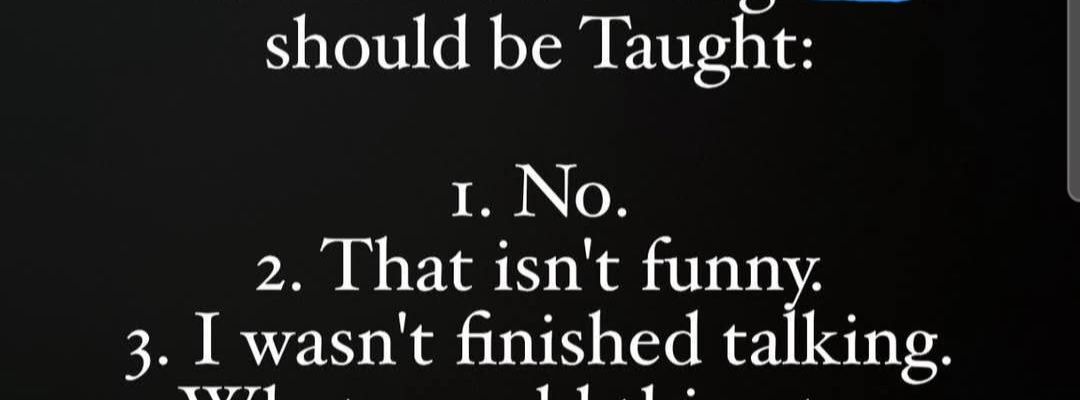
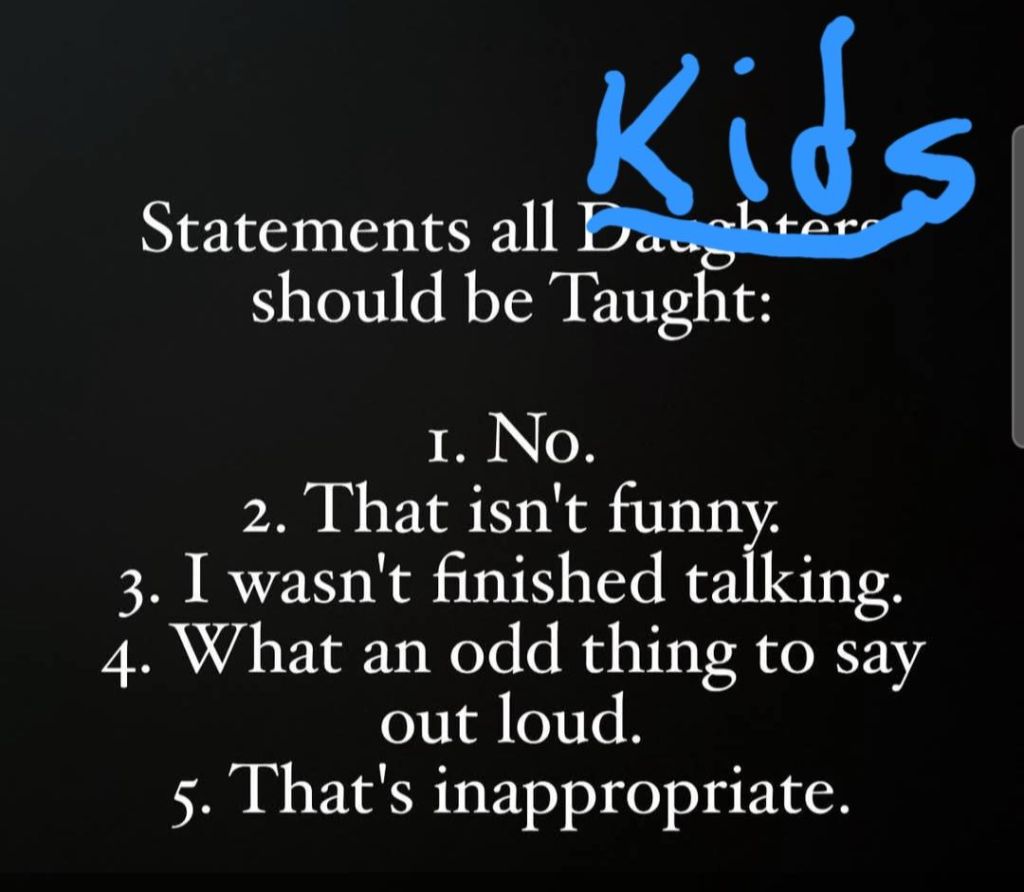
Teaching our kids emotional intelligence can be challenging with how busy we can all be, but when we ourselves model these behaviors it becomes easier. If we tell our kids the above phrases as being important for their future lives as adults but we ourselves aren’t modeling them, not only are we not giving them a chance to live them and practice life within those parameters, but we ourselves aren’t reaping the benefits of a more peaceful, cooperative home.
Here are a few ways we can start to put that into motion:
1. Saying No
Saying no to our kids without caving in to their crying, tantrums, wheedling, or pouting, is imperative to creating adults who understand boundaries, don’t resort to manipulative tactics, and who can be accountable for their actions.
When we teach our kids to accept our no, it’s helpful to give them some age appropriate, short explanations to help them see the bigger picture and to feel a vital part of the family instead of simply being someone everyone orders around.
Our goal is to help them become thoughtful adults who can make good decisions, and not just be forced into obeying, only to later rebel against the adults when they get older. Yes, this takes more time and effort, but it does pay off as they get older.
When we say no and stick to it, we teach them that they can likewise say no and set boundaries as adults and not feel anxious or guilty about setting their own boundaries. If you as an adult struggle to set boundaries without feeling guilty, here are a couple of helpful posts to help you make the changes you need to: Gentle ways to start setting boundaries, Setting “Boundaries with consequences”, and to help you see your patterns and to start developing some healthy boundaries, the Guided Boundaries Journal can be very helpful.
Children need firm boundaries to feel loved, so being indulgent and giving in to their every demand or request doesn’t end up working out for them or their parents in the long run. A parent may think they need to give their kids every advantage to be seen as great parents, but in not setting limits and saying no (and sticking to it), they’re training their kids to be entitled adults who have difficulty in learning to self-regulate themselves.
The word “No” is a challenging one for many parents to incorporate in a consistent, loving way, but as you can see from the above, the long-term consequences can affect their kids entire rest of their lives.
Simply making this one change can be very beneficial, but be forewarned, if you’ve been saying “No” and then backing down because the kids crying or anger has gotten on your nerves, be prepared for them to ratchet up their negative behaviors until they see you’re serious about sticking to the “No”. By sticking it out will end up benefitting the whole family in the long-run.
This is an area that is difficult for many parents to model, but we need to put aside our insecurities of thinking we’ll be seen as not being a “good” parent, but in the long run we become better parents and will have kids who become better at being able to self-regulate, and in turn able to set healthy boundaries with the people around them in their adult lives.
2. “That isn’t funny”
In the past we were made to feel that we needed to tolerate “jokes” made at the expense of others. We were and still are told, “Oh, you’re just being too sensitive! It’s just a joke!”. It used to be common practice to make fun of the people around us to make oneself look somehow superior to them. “I’m great, but you’re not, so I’m going to bring everyone’s attention to how I feel about you, and humiliate you. If you show discomfort, well, we’re going to laugh at that too.”
Is it, really ok? Just because someone chooses to make fun of someone else doesn’t mean it’s actually funny. It’s just meanness thinly disguised as humor.
There’s a lot of mean-hearted people out there, really pissed off that people don’t want to put up with that stuff anymore. “Everything is so politically correct! I just want to crack a joke, but no one has a sense of humor anymore.” Yes, being mean to other and making them the object of ridicule was once seen as being very funny. Not by everyone, but by enough people that it was seen as normal.
Bullying others was seen as showing one was a “top dog” and bullies dared others to challenge them. Unfortunately, bullies in public were bullies in the privacy of the home too. A lot of men did it to their kids in the name of “toughening them up” to be able to face the world out there. They had it done to them so they did it to others.
Bullying over time has negative effects on a person, with many victims turning to drugs or alcohol to numb out the pain that got inflicted.
Thankfully our culture has changed to a degree that being mean-spirited towards others is no longer seen as a way to distinguish oneself. We need to keep calling out mean-spirited behavior.
3. “I wasn’t finished talking”
Interrupting and cutting others off isn’t the mark of a leader or “top-dog”, it’s just poor manners. I came from a city where it was very common for people to interrupt one another, there wasn’t a great understanding of how to converse in a way where people felt heard. That seemed to breed people who stole the whole conversation and turned it into a monologue, which in turn seemed to give others the idea that if they wanted a chance to say anything that they just had to interrupt. I still fall into the interrupting habit, but I have been mindfully working on my listening skills.
Being able to say “I wasn’t finished talking” is an important phrase to remember to use.
4. “What an odd thing to say out loud”
We have a rude cultural idea that we can say anything that comes to our minds, no matter how mean or crude, and then say, “I was just being honest!” The shield of “honesty” hides many a mean or rude person, but when we can calmly say “What an odd thing to say out loud”, we can show it for what it is, and not feel we need to just stay silent.
5. “That’s inappropriate”
Again, we come from a culture that found it funny to say and do things that really weren’t funny, they were mean or rude or wildly off-color. Using this phrase calls out that behavior. No one should be subjected to that kind of “humor” or behavior. We don’t need to pretend to “go along” and be suffering inside or watch someone else suffer.
Emotional intelligence is learned and modeled
People behaving poorly and treating others with distain, humiliation, bullying, aren’t things we need to tolerate. Treating others kindly and with respect are marks of an emotionally mature person. As a culture it is time to grow up out of adolescence and move into adulthood. We can choose that behavior for ourselves and to model it within our families.
People who come from such families and relationships are much happier and more peaceful human beings.
Just because we don’t come from that doesn’t mean that we can’t choose it for ourselves and to create those peaceful home atmospheres. I know many people who have been making those conscious choices, and leaving old way behind.
- Be kind to past versions of yourself that didn’t know the things you now know.
- Small signs you’re liked more than you realize
- Here’s a life lesson in being effortlessly comfortable and “cool”.
- Changing how we see ourselves; moving from dislike when we yearn to be able to go forward into something more positive
- Let your past make you better not bitter.
- Often it’s the deepest pain which empowers you to grow into your highest self.
- This world may never understand you. That is not your fault, that is your gift.
- How to stop taking things personally
- Forget the pain but never the lessons you gained.
- Nothing is set in stone! “What have I got to lose?”
- Are you co-dependent and trying to hang on at all costs?
- Green flagged – people who are considered good people have these traits
♥ ♥ ♥ ♥ ♥
Blessings!
Thank you for liking, sharing this post and for following me!
Tamara
I hope you’ll poke around my Archived Posts Main page divided up into 3 sub-pages: Mental Health and Rewiring the Brain || Healing and Developing Ourselves || Positive thoughts and Affirmations to find a wonderful trove of supportive and encouraging posts!
https://tamarakulish.com/
My books: Now available through Walmart.com!
Developing Happiness When You Can’t Find It and How to Heal Your Life on a Deep Heart Level are available in paperback and Kindle. Audiobooks are available for the busy person!
Guided Journals help you work on a particular issue by answering questions to help see patterns and to find solutions:
Removing Inner Blocks || Anger Journal || Guided Anxiety Journal || Joy & Mindfulness Journal || My Boundaries Journal || My Inner Thoughts Journal
Thanks for buying my books on Amazon!
#writing #InspirationalWriting #art #creativity #strength #mentor #teacher #HappinessGuru #love #growth #healing #life, #inspiration, #quotes #happiness #joy #PersonalGrowth #pain #depression #anxiety #SelfEsteem, #LifeSkills #empowerment #encouragement #support #intuition #journal #consciousness #mind #learn #God #universe #angels #spiritual #spirit #awareness #journal #boundaries #emotionalhealth #mentalhealth #emotions
Discover more from Tamara Kulish
Subscribe to get the latest posts sent to your email.

 Tamara Kulish
Weird that that was originally just daughters. I protest. Thanks for the adjustment. I’ve been having to give some pointers to my son. He plays with the neighbor boy, slightly older, who takes advantage of him. It’s irksome, but I’m working on bolstering my son’s confidence.
LikeLiked by 4 people
Good for you! Yes, I find it irksome too when I see advice aimed at only 1 gender, when it applies to both! We’re all much more alike in how we need to grow, so dividing us up doesn’t help! Thanks for pointing out that flaw!
LikeLiked by 1 person
Thank YOU for pointing out that flaw! 🙂
LikeLiked by 2 people
😉❤️❤️
LikeLiked by 2 people
I totally agree that emotional intelligence is learned and modeled. Thanks for this list, Tamara!
LikeLiked by 2 people
You’re doing a great job of that with your kids Wynne! Kudos!
LikeLiked by 1 person
An excellent post, Tamara, that deals with an important issue. My sons hated me for saying “no” to things that their friends were allowed to do. I like the polite way of saying “What an odd thing to say out loud” instead of “You’re being rude/mean.”
LikeLiked by 2 people
Lol, I struggled with saying no, or rather keeping it a no. My daughter was a champion negotiator often convincing me! I had to learn to better manage that skill later on.
LikeLiked by 2 people
😀
LikeLiked by 2 people
That is the one thing Spirit has shown me above all else. Those ‘kids’ should indeed be given a fair base to stand on growing up. I said to Spirit we should put these understandings in schools for parents and children, to give them all a fair start…but it never is. Simply because those we love and look up to all have their own ‘issues’, have not resolved these and just pass on what they are. They cannot be but what they are. And of all places…do we remember the horrors we went through at school? Mind you, those places taught us much, even if reinforcing our fears too. But yes you are correct, it must come from us, as parents, first.
It is a complicated world but those experiences are indeed the making of us. To go through what holds us, understand them and set us free. Eventually.
Great post Tamara, finding those teachings will cross our paths. Adult or children. Thank you for sharing kind lady, your words are that wisdom found in experiencing them all. May they encourage others to step into it 🤗❤️🙏
LikeLiked by 2 people
Thanks Mark, yes, we parents come with our baggage and struggle to parents effectively. Parenting styles have swung from one side of the pendulum of strictness to the other side. We need to find a balanced ground of providing boundaries and guidelines for our youngsters. Part of the problem was parents thinking they didn’t need to do the hard work, and instead leave it to the overwhelmed schools, allowing them to be friends with their kids. We need to stop handing off the parenting to the teachers, and bring it back home. It can be done in a loving, kind way, while keeping boundaries in place. We have more growth to do as a society!
LikeLiked by 1 person
Yes indeed, that growth and balance is a never ending story. And I do mean that parents should be a part of that classroom. As in, they turn up with their children to do ‘interactions’ of what should, can, and be worked out in those relationships. Many are so damaged emotionally and they need that counselling (as part of that classroom), as do the kids on the other end of it. Heal the instructors (parents) so to speak. Spirit even said that this will have its drawbacks because parents won’t feel they need it, feel confronted by it, and other issues like work time etc. I think it will be the only way to face those issues at home and at the least heal those relationships of parent and child. Anyway, it has a purpose, hard as it is 🤗❤️🙏
LikeLiked by 2 people
I totally agree that parents would feel attacked if confronted about their parenting styles by anyone. These issues are best tackled by themselves, possibly with the help of a counsellor or life coach to work on overcoming issues from one’s past. Thankfully, when we make changes, we can do so one thing at a time. We don’t need to tackle everything all at once, for that would be daunting. I advocate for tackling issues bit by bit, for that way is much less intimidating.
LikeLiked by 2 people
Very true Tamara, I pray a gentle approach may be found for all to find that place of balance 🤗❤️🙏
LikeLiked by 2 people
Me too Mark, me too!
LikeLiked by 2 people